It’s hard to imagine a more delicate moment to make this announcement. While the International Agricultural Show is in full swing in France, the President of the European Commission, Ursula von der Leyen, announced on Friday February 27 that the free trade agreement between the European Union (EU) and the Mercosur countries would be applied as a ” provisional “even before its complete ratification. After more than twenty-five years of negotiations and an official signing in January, this commercial treaty is entering its operational phase.
Negotiated with Brazil, Argentina, Paraguay, Uruguay and Bolivia, the agreement is presented by Brussels as a major economic and geopolitical lever for the EU. However, it arouses particularly broad opposition in France, where it crystallizes the concerns of the agricultural world, environmentalists and the entire political class.
In reaction to the announcement of Mme von der Leyen, Emmanuel Macron denounced a “bad surprise”while the Minister of Agriculture, Annie Genevard, said “regret” a decision “very damaging”socket “in defiance of respect which should have prevailed over the decision of the European Parliament”.
What exactly does this trade agreement contain? Why is it the subject of such massive rejection in France? And what does its provisional application change? Here are five points to understand everything.
What does this agreement consist of?
This is a free trade treaty negotiated for more than a quarter of a century between the EU and the countries of the Southern Common Market, or Mercosur (for Mercado comun del Sur), a South American trade bloc bringing together Brazil, Argentina, Paraguay, Uruguay and Bolivia (the latter, having joined the group late, does not however participate in the agreement).
The treaty contains several measures aimed at facilitating trade between the two zones: the gradual elimination of almost all customs duties, protection against imitation of 344 European products (Roquefort, Comté, champagne, etc.), or the opening of new import quotas in Europe, particularly for South American beef (99,000 tonnes per year).
The EU hopes to boost the export of European products – cars, clothing, wine – on which Mercosur countries apply high customs duties. With 780 million consumers and between 40 billion and 45 billion euros in annual imports and exports, it is the largest trade treaty ever signed by the EU, and a way for it to diversify its outlets, in a context of tensions with the United States and China.
Concluded on June 28, 2019, the agreement remained in draft form for several years, blocked by the reluctance of several countries on both sides of the Atlantic, including France, before being officially signed in January 2026.
Why is it contested in France?
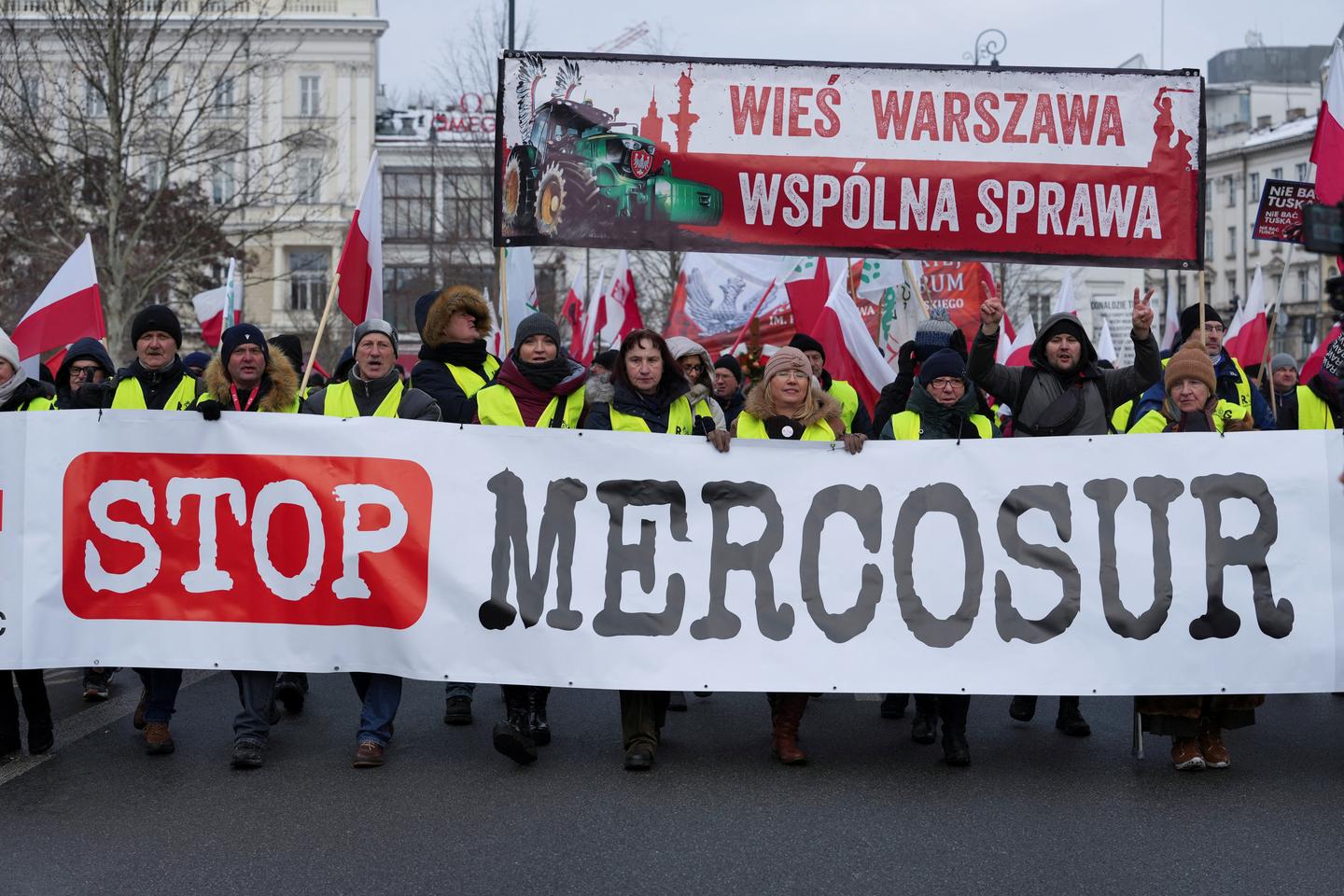
In France, the EU-Mercosur agreement arouses almost general opposition from all political forces, from the radical left to the far right, and the rejection of the main agricultural unions.
The criticism mainly focuses on the risk of a massive arrival of South American foodstuffs, in particular beef, perceived as unfair competition for French agricultural sectors. Meat produced in Brazil or Argentina is significantly cheaper than European meat, due to lower production costs (land, labor, animal feed) and less restrictive health and environmental standards (use of pesticides and antibiotics).
These deviations from standards also fuel criticism from environmentalists. According to them, the agreement could increase long-distance trade, increase greenhouse gas emissions, encourage deforestation of the Amazon, and endanger the health of consumers with the importation of products that do not comply with European standards.
What is France’s positioning?
The French president, Emmanuel Macron, was initially favorable to the agreement, at the time of its conclusion, in June 2019. He claimed at that time to have obtained from Jair Bolsonaro, then president of Brazil (2019-2023), the introduction of a clause binding the country to respect its climate commitments and to have prevented the far-right leader from leaving the Paris climate agreement, as he threatened to do.
However, a few weeks later, in August 2019, Emmanuel Macron backtracked during the G7 in Biarritz (Pyrénées-Atlantiques). As fires ravage the Amazon, the Head of State denounces the inaction of his Brazilian counterpart in favor of the climate and biodiversity. He decides to withdraw French support for the EU-Mercosur agreement.
Subsequently, without rejecting the project outright, France argued for renegotiating it in order to include protective clauses for the environment and European farmers. Paris demanded in particular the establishment of mirror clauses, which would impose identical standards on products traded between EU and Mercosur countries, but also the tightening of the safeguard clause, a mechanism which allows the European Commission to temporarily restore customs duties if trade in certain sensitive products (chicken, beef, sugar, ethanol) explodes, at the risk of destabilizing the market. France has proposed being able to activate this clause if import volumes increase by more than 5% or if prices fall by more than 5% compared to an average calculated over three years. Member States and Parliament finally agreed, in December 2025, on a less demanding rate of 8%.
What is “provisional application”?
By announcing a “provisional application” of the Treaty, the European Commission activates a mechanism provided for in Article 218 of the Treaty on the Functioning of the EU. This text allows the Council of the EU, on a proposal from the European Commission, to decide that an international agreement will be applied even before the end of its ratification process (which can be long).
In the case of the EU-Mercosur Treaty, this means that the provisions falling within the exclusive competence of the EU – the trade aspect, including the gradual abolition of customs duties – can begin to apply without waiting for the final vote by the European Parliament or formal ratification by all member states. However, Parliament will always ultimately have to decide: in the event of rejection, the application would be interrupted.
If it is contested because of the heated debate around Mercosur, the provisional application is not unusual. CETA, the agreement between the EU and Canada, has for example been applied provisionally since 2017, due to the reluctance of several countries, including France, to ratify it.
Can France refuse to apply this treaty?
France cannot, alone, refuse to apply the EU-Mercosur agreement. Trade policy falls under the exclusive competence of the EU: once the decision is adopted at European level, member states are required to comply with it.
With the activation of provisional application, the commercial provisions of the text will therefore soon begin to apply, including in France, without awaiting final approval from the European Parliament. To be fully ratified, however, the agreement must still be approved by MEPs, where a favorable majority is not completely achieved. In the event of rejection, its application must be interrupted.
Updated January 12: updating of the planned date of signing of the agreement in Paraguay.
Updated February 27: update after the announcement of provisional application.
#EUMercosur #agreement #questions #understand #stand