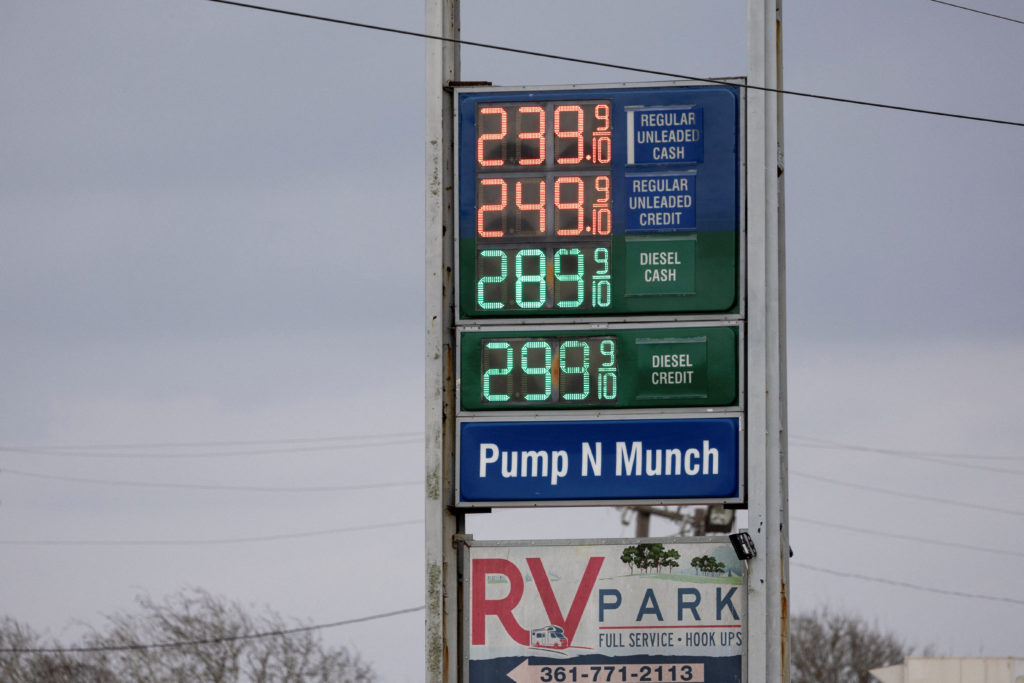
Introduction: Reeves to respond to spring forecast after oil and gas prices surge
Good morning.
“Events, dear boy, events”. Rachel Reeves may have the (probably apocryphal, oft-quoted) wisdom of Harold Macmillan in mind today, as she responds to the latest official assessment of the UK economy.
The Office for Budget Responsibility’s new Spring Forecast could, in happier times, have brought the chancellor good news this afternoon.
Economists predict they will show that the UK is still keeping within the OBR’s fiscal forecasts – helped by a record budget surplus in January – and that inflation is heading down towards target.
However, the Middle East crisis mean such predictions are out of date before they’re even published, as the world faces the threat of a new energy crisis.
Yesterday, liquefied natural gas (LNG) prices rocked by over 40%, and oil rose by over 7%, after Qatar’s state-run energy firm halted LNG production and Saudi Arabia temporarily shutting down some units of its massive Ras Tanura oil refinery following attacks by Iran.
These moves, as the US-Israel war on Iran rages, risk reigniting the cost-of-living crisis.
As economists at Investec explain:
The main economic consequence of higher energy prices would be to boost inflation.
In the UK, illustratively, the current level of the oil price would, if maintained, add about 0.2%pts to headline inflation via higher petrol prices; and a sustained 40% shift up in natural gas price futures would boost this by a further 0.7%pts or so, via higher household utility bills.
We’re not expecting major policy changes today, as the government has committed to holding just one major fiscal event each year in the autumn. That’s why it’s billed as the ‘spring forecast’ not the ‘spring statement’.
Instead the chancellor is expected to insist the government has the “right economic plan for the country” in a “yet more uncertain” world.
Reeves is expected to tell MPs:
“Stability in the public finances, investment in infrastructure and reform to our economy.
Building growth not on the contribution of a few people or a few parts of the country, but in every part of Britain with a state that doesn’t stand back, but steps up.”
The agenda
-
8am GMT: Worldpanel supermarket inflation and sales figures
-
9.30am GMT: ONS data: Mergers and Acquisitions involving UK companies: October to December 2025
-
10am GMT: Flash estimate of eurozone inflation in February
-
12.30pm GMT: spring forecast statement from Chancellor Rachel Reeves
-
1pm GMT (roughly): Office for Budget Responsibility’s spring forecasts published
-
2.30pm GMT: Office for Budget Responsibility press conference
Key events
UK bond yields jump as investors anticipate inflation spike
Government bond prices are slumping today, as investors anticipate an inflationary shock from the Middle East crisis that will make it harder to cut interest rates.
UK bonds are under pressure, driving down prices which lifts the yield, or interest rates, on the debt.
The yield on 10-year UK bonds has jumped by 11 basis points (0.11 percentage points), with 30-year yields up 9bps.
Shorter-dated bonds are suffering too, pushing up the yield on two-year bonds by 13.5bps now.
This follows today’s jump in oil and gas prices, which threaten to push up inflation.
That’s why the chances of a cut to UK interest rates this month have now fallen below 30%. The markets are also only pricing in one Bank of England rate cut this year, down from the two expected last week.
Neil Wilson, investment strategist at Saxo UK, says:
On the whole selling in stocks and bonds remains orderly and nowhere near pricing a worst-case scenario.
Spring Statement today – chancellor Rachel Reeves will deliver a message of stability amid the chaos.
The worry is the rise in yield eroding headroom as inflation risks push back the Bank of England’s rate-cutting schedule. The 10yr gilt yield has jumped since the weekend from a little above 4.2% to above 4.4%.
The markets see fewer US interest rate cuts this year too.
According to Bloomberg’s David Finnerty, at the end of last week the swaps markets priced in 61 basis points of cuts in 2026 by the US central bank. Now its down to 46 points – which would mean fewer than two quarter point cuts from the Fed this year.
IMF: We are monitoring Middle East situation closely
The International Monetary Fund has just released a statement on the Middle East crisis.
In it, the IMF points out the crisis has already disrupted trade and economic activity, rocked the financial markets, and driven up energy costs.
It will give a “comprehensive” view of the economic impact of the crisis in April, when it releases its next set of economic forecasts.
The Fund says:
We are closely monitoring developments in the Middle East. So far, we have observed disruptions to trade and economic activity, surges in energy prices, and volatility in financial markets.
The situation remains highly fluid and adds to an already uncertain global economic environment. It is too early to assess the economic impact on the region and the global economy. That impact will depend on the extent and duration of the conflict.
We will provide a comprehensive assessment in our April World Economic Outlook.
Victoria Scholar, head of investment at interactive investor, sums up the situation in the markets today, with the UK’s FTSE 100 index now down 2.25% or 240 points:
Almost all stocks on the FTSE 100 are in the red with only one notable gainer, Smith & Nephew thanks to a price target upgrade from Barclays. Miners and financials are among the biggest losers including Antofagasta, Barclays, Anglo American and Prudential, reflecting the increased geopolitical risk in the Middle East. Intertek has also plunged on the back of earnings.
Oil continues its ascent with Brent and WTI both up close to 4% extending gains after brent crude jumped over 7% on Monday. This was its biggest daily gain since March 2022 pushing the benchmark above $80 a barrel, sparking fears about resurgent inflation. European natural gas prices are also surging around 20% this morning after Qatar decided to stop production. The war between Iran and the US and Isael has intensified after a US embassy in Riyadh was reportedly hit by drones and Isarael attacked Tehran and Beirut.
Gold and the dollar are also staging gains with the precious metal logging its fifth consecutive positive day, rallying beyond Monday’s four-week high. The US dollar is pushing higher against EUR, GBP, JPY and AUD.
Despite the intensity of the conflict, US equities were remarkably resilient on Monday with the Nasdaq and the S&P 500 closing modestly higher while the Dow ended just below the flatline. However, US futures are pointing to a weaker session on Wall Street with all three major averages on track to open down by more than 1% eac
Pound hits 2026 low
The pound has hit its lowest level against the US dollar in almost three months this morning.
Sterling is down 0.8% against the dollar, or around one cent, to $1.33, the lowest since 10 December.
The dollar is continuing to rally against other currencies, as investors shift their money into safe haven assets.
FTSE 100 slump deepens
The London stock market is plunging deeper into the red – a dreadful backdrop for the chancellor’s statement this lunchtime.
The FTSE 100 index of blue-chip shares has now tumbled by 215 points, or 2% 1.8%, to 10,564 points.
That’s its lowest level in almost two weeks, and leaving the Footsie on track for its worst day in 11 months – since the ‘Liberation Day’ tariff shock of April 2025.
Chances of UK interest rate cut in March tumble
The chances of a UK interest rate cut this month are plummeting, as the Middle East crisis drives up oil and gas prices.
The money markets now indicate there’s just a 29% chance that the Bank of England lowers interest rates at its next meeting, 19 March. That’s down from 80% last week, before the Iran war erupted.
The interest rate, or yield, on UK two-year bonds has surged today too – up 12 basis points (0.12 percentage points) as the City anticipate that a rate cut is much less likely, given fears of an inflation spike.
That will disappoint borrowers hoping for cheaper interest rates…. and is also a blow to Rachel Reeves, who has taken the credit for the six rate cuts since August 2024.
Jemma Slingo, pensions and investment expert at Fidelity International, says:
“Stubbornly high oil and gas prices could impact economies around the world. Specifically, they could be inflationary and disrupt plans to cut interest rates. The Bank of England is due to announce its next rate decision on 19 March. The bank’s Monetary Policy Committee has held several nail-biting votes in recent months, and conflict could complicate things further.
“For now, however, there is no certainty around what will happen to energy supplies or what this means for the global economy.
UK grocery inflation rises
UK grocery price inflation has risen, showing that people are being hit in the pocket even before the surge in energy prices feeds through to the economy.
Data provider Worldpanel by Numerator has reported that annual grocery inflation rose to 4.3% in February, after four consecutive months of falls, in a blow for households. That’s up from 4% in January.
FTSE 100 sheds 1% as European markets fall again
European stock markets have opened with fresh falls, as the Middle East crisis continues to grip bourses around the region.
In London the FTSE 100 share index has dropped by 104 points, or almost 1%, to 10,667 points at the start of trading, a one-week low.
Insurance group Prudential (-3.5%) are the top fallers, followed by precious metals producer Fresnillo (-3.6%), and mining giants Antofagasta (-3.5%) and Anglo American and (-3.2%).
There are only seven risers on the index, including energy producers BP (+1.6%) and Shell (+0.35%).
Derren Nathan, head of equity research at Hargreaves Lansdown, says:
Sentiment towards BP and Shell has strengthened significantly off the back of oil price spikes. But it’s a complex picture. Neither company has production in Iran. But BP’s significant production in Iraq and Abu Dhabi risks being bottlenecked through disruption to the Strait of Hormuz. For Shell the same applies to its LNG facilities in Qatar and the Emirates. If a moderate sustainable regime is established in Iran, there is the potential for substantial derisking, and for prices to be rebased downwards. If sanctions are removed, it also opens the door for investment into Iranian oil fields.
But uncertainty remains high. This could prove to be highly profitable for both Shell and BP’s trading arms with Shell’s optimisation capabilities in LNG transit likely to be in particularly strong demand. Shell’s balance sheet strength also leaves it better placed to deal with any prolonged volatility and while BP’s buybacks remain on pause, we’re expecting Shell’s generous payouts are likely to continue this year.
Germany’s DAX index has fallen by 1.75%, Spain’s IBEX lost 1.4% at the open and France’s CAC 40 is down by 1.25%.
Julia Kollewe
Heathrow boss Thomas Woldbye received a total pay package of £3.8m last year – up 14% from £3.3m in 2024, despite the controversy around his handling of the power outage at the airport in March that messed up the travel plans of 200,000 passengers.
Or rather non-handling, as he was fast asleep, leaving Heathrow’s chief operating officer Javier Echave to deal with the outage, after a fire at a nearby substation knocked out power supplies to the airport.
Woldbye later expressed his “deep regret” at being uncontactable and sleeping through the crisis The outage at Europe’s busiest airport has raised questions over the resilience of the UK’s ageing national infrastructure.
A Heathrow-commissioned inquiry run by former transport secretary Ruth Kelly found Woldbye was not woken by emergency notification alerts and several calls from Heathrow’s chief operating officer because his mobile had gone into silent mode “without him being aware” and he described it as a “technical glitch”. Asked at a later event in Westminster if he had since obtained “an extra loud phone,” Woldbye replied: “Oh, absolutely. And more.”
The company’s annual report shows his annual bonus rose to £1.4m from £1.3m last year, while long-term share bonuses bonuses increased to £1.3m from £1.1m. His salary was also raised, to £850,000 from £775,000. His benefits including a cash travel allowance climbed by 16% to £130,977 and pension contributions were up 4.7% to £87,006.
UK gas price contract soars again
UK gas prices are climbing – adding to the risks of an inflation spike.
The month-ahead UK gas futures contract, for delivery in April, is up 18% this morning at 135.5p per therm, following a 40% jump on Monday
That’s the highest since February 2025, and almost twice as high as its level in the middle of last month.
However, it’s still much lower than in the early days of the Russia-Ukraine war in 2022, when the month-ahead gas price briefly rose over 500p/therm.
The pound is weakening again this morning too, approaching lows seen during yesterday’s volatile trading.
Sterling is down two-thirds of a cent, or 0.5%, at $1.3342 against the US dollar, which is up against a basket of other currencies too.
Oil rising again
The oil price is rising again this morning, as the Middle East crisis threatens energy supplies.
Brent crude, the international benchmark, is up 3.2% at $80.24 a barrel, adding to Monday’s 7.2% rise.
There is ongoing confusion over the status of navigation in the strait of Hormuz after a general in Iran’s Revolutionary Guards threatened to “burn any ship” seeking to navigate the waterway, a vital route for oil and gas shipments.
But US Central Command said the strait – through which a fifth of global oil and gas travel – was not closed, according to Fox News.
However, leading maritime insurers have cancelled war risk cover for vessels operating in the Gulf, driving up freight costs and deterring shipping companies from sailing through the strait.
Rachel Reeves’s plans could be hit by Middle East conflict, say economists

Heather Stewart
Soaring global energy prices as a result of the widening Middle East conflict will jeopardise Rachel Reeves’s plan to conquer inflation and rekindle growth, economists have warned as she prepares to deliver her spring forecast later today.
Responding to the latest projections from the independent Office for Budget Responsibility (OBR), the chancellor will insist she has “the right economic plan for our country, in a world that has become more uncertain”.
The new forecasts are expected to show the public finances moving in the right direction, with the £22bn fiscal buffer she left herself against her fiscal rules in the November budget little changed.
However, experts said the OBR projections could soon look out of date, if Monday’s surge in oil and gas prices proves long-lasting.
Asia-Pacific shares drop again
Asia-Pacific stock markets have fallen again today, as the Middle East crisis continues to alarm investors.
In Tokyo, the Nikkei 225 index has fallen by 3%, while China’s CSI 300 index is down 1.5%.
In South Korea, where the stock market was closed yesterday, the KOSPI index has tumbled by almost 8%.
Ipek Ozkardeskaya, senior analyst at Swissquote, says:
Geopolitical risks are rising – not easing. Volatility is increasing alongside trade and geopolitical uncertainty, and the risk of renewed inflation could tighten global financial conditions.
ECB’s top economist: Lengthy Iran war could cause inflation ‘spike’
The European Central Bank’s chief economist has warned that a prolonged war in the Middle East and a persistent fall in oil and gas supplies from the region could cause a “substantial spike” in inflation.
Philip Lane has told the Financial Times said that “directionally, a jump in energy prices puts upward pressure on inflation, especially in the near term.”
Lane said the impact would depend “on the breadth and duration of the conflict”, adding:
“The impact would be amplified if it also gave rise to a repricing of risk in financial markets”.
Introduction: Reeves to respond to spring forecast after oil and gas prices surge
Good morning.
“Events, dear boy, events”. Rachel Reeves may have the (probably apocryphal, oft-quoted) wisdom of Harold Macmillan in mind today, as she responds to the latest official assessment of the UK economy.
The Office for Budget Responsibility’s new Spring Forecast could, in happier times, have brought the chancellor good news this afternoon.
Economists predict they will show that the UK is still keeping within the OBR’s fiscal forecasts – helped by a record budget surplus in January – and that inflation is heading down towards target.
However, the Middle East crisis mean such predictions are out of date before they’re even published, as the world faces the threat of a new energy crisis.
Yesterday, liquefied natural gas (LNG) prices rocked by over 40%, and oil rose by over 7%, after Qatar’s state-run energy firm halted LNG production and Saudi Arabia temporarily shutting down some units of its massive Ras Tanura oil refinery following attacks by Iran.
These moves, as the US-Israel war on Iran rages, risk reigniting the cost-of-living crisis.
As economists at Investec explain:
The main economic consequence of higher energy prices would be to boost inflation.
In the UK, illustratively, the current level of the oil price would, if maintained, add about 0.2%pts to headline inflation via higher petrol prices; and a sustained 40% shift up in natural gas price futures would boost this by a further 0.7%pts or so, via higher household utility bills.
We’re not expecting major policy changes today, as the government has committed to holding just one major fiscal event each year in the autumn. That’s why it’s billed as the ‘spring forecast’ not the ‘spring statement’.
Instead the chancellor is expected to insist the government has the “right economic plan for the country” in a “yet more uncertain” world.
Reeves is expected to tell MPs:
“Stability in the public finances, investment in infrastructure and reform to our economy.
Building growth not on the contribution of a few people or a few parts of the country, but in every part of Britain with a state that doesn’t stand back, but steps up.”
The agenda
-
8am GMT: Worldpanel supermarket inflation and sales figures
-
9.30am GMT: ONS data: Mergers and Acquisitions involving UK companies: October to December 2025
-
10am GMT: Flash estimate of eurozone inflation in February
-
12.30pm GMT: spring forecast statement from Chancellor Rachel Reeves
-
1pm GMT (roughly): Office for Budget Responsibility’s spring forecasts published
-
2.30pm GMT: Office for Budget Responsibility press conference
#Spring #forecast #Reeves #insist #economic #plan #Markets #plunge #Middle #East #crisis #drives #oil #gas #prices #live #updates